



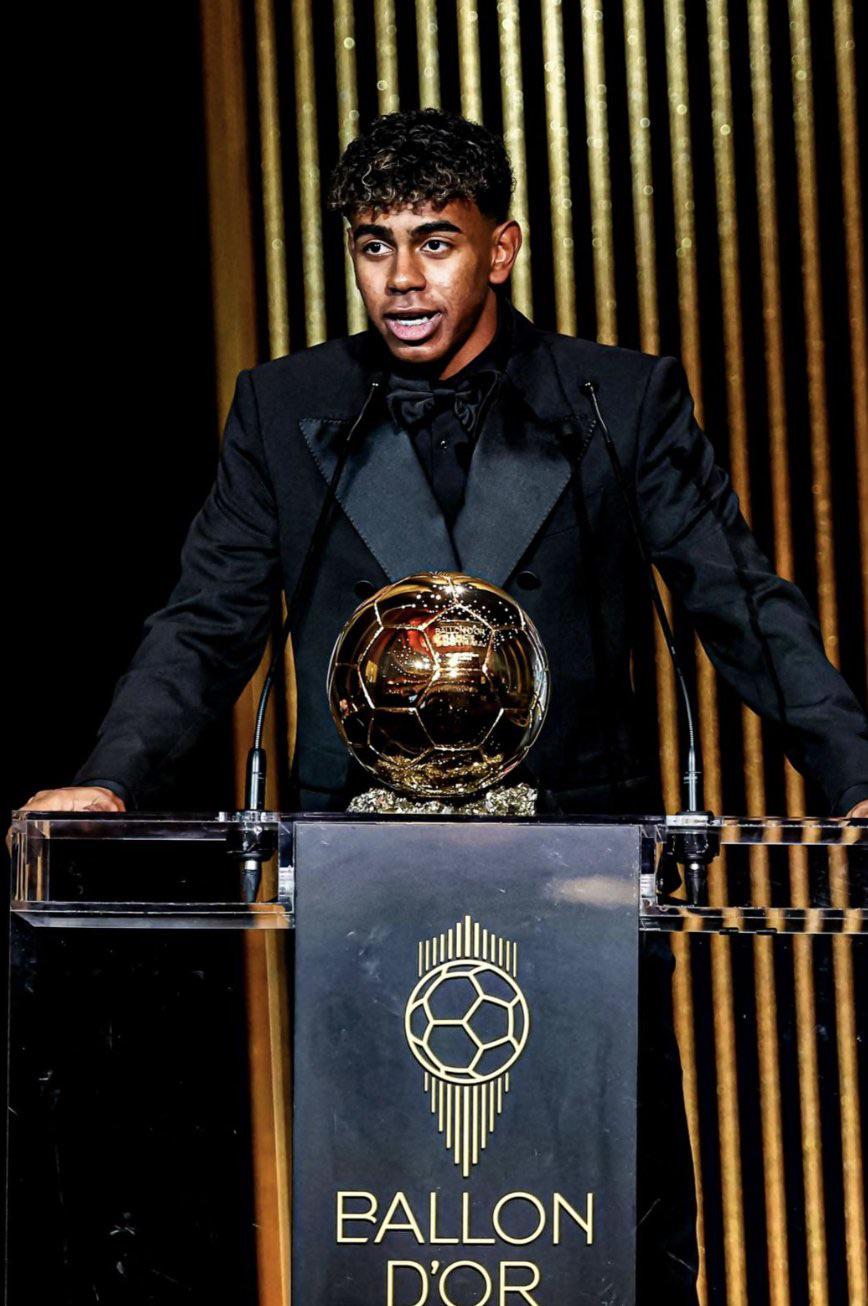
The whisper began as a murmur, a speculative hum among the digital denizens of football’s sprawling online agora. Then it grew, fueled by bewildering flashes of brilliance, audacious dribbles, and a fearlessness that belied his tender years. Now, it’s a full-throated roar in some corners: Lamine Yamal for the Ballon d’Or.
To even utter such a proposition, to consider a player barely old enough to vote for the sport’s most prestigious individual accolade, feels almost blasphemous to football traditionalists. It challenges the very fabric of what we understand the Ballon d’Or to represent: the pinnacle of a player’s performance over a calendar year, usually achieved after years of honing their craft, battling through physical and mental gauntlets. It is a reward for sustained, elite-level contribution, not merely breathtaking potential.
Yet, dismissing the Lamine Yamal Ballon d’Or conversation as mere hyperbole, as the fleeting fancy of a generation weaned on instant gratification, would be to miss a far deeper, more fascinating undercurrent in modern football. It is a conversation less about his current concrete achievements – though they are remarkable for his age – and more about the radical redefinition of ‘impact’ and ‘potential’ in a sport accelerating at warp speed.
The Phenomenon: An Unprecedented Ascent
Let’s first address the undeniable: Lamine Yamal is not just a talent; he is a phenomenon. His rise has been less a climb and more a vertical ascent, shattering records with the nonchalance of a teenager choosing a TikTok filter. Youngest ever to play for Barcelona. Youngest ever to score in La Liga. Youngest ever to feature for Spain. Youngest ever to score for Spain. Youngest to start in a Champions League knockout game. The list, almost comically, goes on and on.
These aren’t just statistical curiosities; they are markers of a generational anomaly. To witness Yamal play is to see a player who thinks several seconds ahead of his opponents, whose touch is balletic, whose vision is panoramic, and whose courage to take on defenders is almost a defiance of physics. He possesses that intangible ‘X-factor’ – a joy in his play that is infectious, a raw, untamed artistry that makes you lean forward in your seat.
He has already shown he can influence major games, create decisive moments, and, crucially, shoulder immense pressure at an age when most are still refining their technique in youth academies. His ability to perform under the unforgiving spotlight of Camp Nou and on the international stage suggests a mental fortitude rarely seen in one so young.
The Traditionalist’s Retort: A Matter of Merit, Not Magic
However, the Ballon d’Or, historically, is not a prize for potential. It is a prize for realised excellence over a specific period. And here, the traditionalist view holds significant weight.
The names etched onto that golden sphere – Messi, Ronaldo, Cruyff, Platini, Zidane, Modric – are not just individual stars; they are players whose calendar years were defined by epoch-making performances, decisive goals in major finals, league titles, Champions League trophies, or international glory. Their contributions were quantifiable, sustained, and often directly correlated with team success at the highest level.
Yamal, for all his breathtaking moments, is still accumulating those achievements. He is an integral part of a Barcelona side that is in transition, not yet a dominant force. He is a key player for Spain, but they are also building. While his individual statistics for goal contributions are impressive for his age, they do not yet rival the sheer volume and critical impact of those who have lifted the Ballon d’Or. He hasn’t yet led a team to major silverware as the undeniable, primary protagonist.
To hand him the Ballon d’Or now would be to dilute the award’s meaning. It would shift its focus from ‘best player of the year’ to ‘most exciting prospect of the year,’ or even ‘player who offers the most hope for the future.’ While those are valuable conversations, they are not, and have never been, the Ballon d’Or conversation.
Furthermore, the physical demands on a young player are immense. To expect Yamal to maintain such a peak, high-impact performance for an entire calendar year, competing against seasoned veterans who have mastered the art of pacing and consistency, is perhaps an unfair burden. The award demands not just flashes, but an unrelenting blaze.
The Nuance: Redefining Impact in the Modern Game
But what if the traditionalist view, while historically valid, is beginning to fray at the edges in the face of modern football’s relentless evolution?
The very nature of “impact” is changing. In an era of sophisticated analytics, micro-data, and pervasive social media, the influence of a player is no longer solely measured by goals and assists, or even trophies. It’s about market value, brand recognition, digital engagement, and the sheer ‘event’ quality a player brings to every match.
Lamine Yamal, even at his tender age, is already a cultural phenomenon. He draws eyeballs. He sells jerseys. He creates viral moments that transcend the sport itself. His presence on the pitch elevates the excitement, regardless of the scoreline. In a commercialized sport, this intangible ‘star power’ holds immense sway.
Moreover, his emergence comes at a time when the previous duopoly of Messi and Ronaldo, who monopolised the award for over a decade, has finally loosened its grip. The field is more open, more diverse. There is an appetite for a new narrative, a new face. Yamal, with his electrifying style and fresh-faced enthusiasm, perfectly fits that void.
The argument for Yamal, then, isn’t that he has definitively out-performed every other elite player in a traditional statistical sense over a calendar year. It’s that his presence and potential impact are so profound, so utterly unique, that they force us to reconsider the metrics of excellence. He is not just playing football; he is rewriting the script of what is possible for a teenager in the sport.
The Peril of Premature Coronation
However, there’s a genuine danger in premature coronation. Placing the weight of the Ballon d’Or on such young shoulders, however broad they may seem, could be counterproductive. The history of football is littered with ‘next big things’ who buckled under the pressure or whose development was stunted by excessive expectation.
The Ballon d’Or is not a development prize. It’s the ultimate validation. To bestow it too early could set an impossible standard, distort the focus from continuous improvement to individual accolades, and potentially expose Yamal to an unfair level of scrutiny and criticism should his form dip, as it inevitably will for any young player.
His journey is just beginning. What he needs now is continued game time, tactical refinement, physical development, and the freedom to express himself without the crushing burden of being ‘the best in the world’ before he’s even reached his physical prime.